UMKAY LEARNING LAB
The first answer is a draft, not a verdict.
Use critique, correction, alternatives, narrowing, expansion, and assumption checks to improve ChatGPT answers.
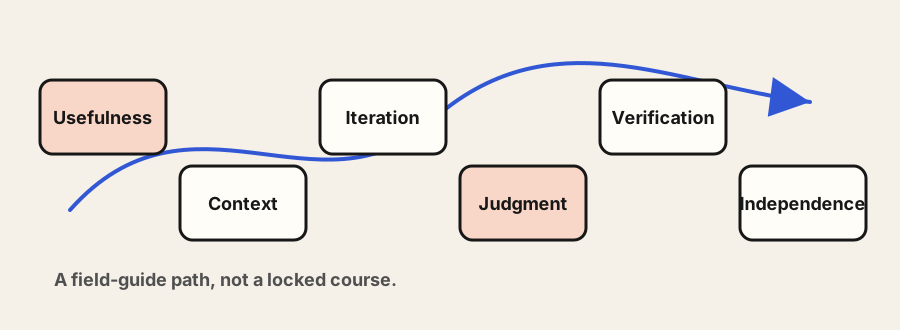
Iteration is where the value appears
Expecting a perfect first answer is the wrong working model. A useful AI conversation usually moves through critique, correction, steering, alternatives, narrowing, expansion, and assumption checks. You are not bothering the tool by revising. You are doing the work of directing it.
Good follow-ups are concrete: 'Keep the structure but make the examples less formal.' 'You assumed we have admin access; we do not.' 'Give me three options with tradeoffs.' 'Make the recommendation, then list what could make it wrong.' 'Compare this version to the previous one and preserve the stronger parts.'
A short multi-turn example
Turn one: 'Draft a message asking for a deadline extension.' The answer is polite but vague. Turn two: 'Make it specific: I need two extra business days because the vendor file arrived late. Do not over-apologize.' Better, but still soft. Turn three: 'Add a clear delivery date and one sentence about what is already complete.' Now the output can be used.
The user did not need a secret prompt. The user needed to notice what was missing and steer toward the real objective.
Preserve the objective
Long conversations can drift. Re-anchor the work: 'The real goal is still to help me decide, not to write more.' Ask the model what assumptions it is using. Ask it to identify missing information. Ask for a version that takes the opposite position when you need to test your own bias.
Iteration should make you more capable. If the conversation is only making you ask for endless rewrites, stop and decide what you actually need.